
Microbiome-Host-Cancer Interface: A Narrative Review of Therapeutic Strategies, Current Challenges, and Global Opportunities
-
Saheed Ayodeji Adekola
Department of Medical Laboratory Science, Faculty of Allied Health Sciences, University of Abuja, Abuja, Nigeria
Yusuf Dimeji Igbayilola

Department of Physiology, College of Medicine, Federal University of Health Sciences, Ila-Orangun, Osun State, Nigeria
Dolapo Pius OparindeDepartment of Chemical Pathology, College of Health Sciences, Ladoke Akintola University of Technology, Ogbomoso, Nigeria
Samson Olawale AinaDepartment of Physiology, College of Medicine, Lagos State University, Ikeja, Lagos, Nigeria
Ngabea Murtala AuduDepartment of Medicine, Maitama District Hospital/College of Medicine, Baze University, Abuja, Nigeria
| Received 10 Jul, 2026 |
Accepted 08 Oct, 2026 |
Published 10 Oct, 2026 |
Background and Objective: The human microbiome is critical in carcinogenesis and treatment outcomes. Here, we discuss microbiome-host interactions, synthesise clinical evidence on targeted interventions, and consider challenges in translation. It examines cost-effective, scalable microbiome strategies to advance oncology care in low- and middle-income countries (LMICs) with emphasis on biomarker discovery and standardisation of research. Materials and Methods: We performed a narrative search of PubMed, Scopus, and Web of Science to identify peer-reviewed studies published from January 2010 through April 2026. The screening was focused on cancer-microbiome host interactions, mechanisms, efficacy, safety, and applicability for global health. For this review, a total of 150 eligible studies, including preclinical models, observational studies and clinical trials, were critically analysed. Results: The microbiome controls carcinogenesis through genotoxicity (e.g., colibactin from pks+ E. coli), chronic inflammation, T-cell priming and bioactive metabolites. In the clinic, faecal microbiota transplantation (FMT) and synbiotics improve anti-PD-1/PD-L1 response in refractory melanoma and reduce chemotherapy-induced mucositis and diarrhoea. Nevertheless, significant translational challenges include significant inter-individual heterogeneity, inconsistent strain engraftment, risk of opportunistic infection in immunocompromised patients and fractured regulatory frameworks. Conclusion: Microbiome intervention improves efficacy and reduces toxicity of cancer therapies. In settings with limited resources, inexpensive prebiotics and probiotics can be easily added to oncology care. Prioritisation is needed for global clinical translation of biomarker discovery, standardisation of research protocols, and inclusion of LMIC populations in trials.
| Copyright © 2026 Adekola et al. This is an open-access article distributed under the Creative Commons Attribution License, which permits unrestricted use, distribution, and reproduction in any medium, provided the original work is properly cited. |
INTRODUCTION
The human microbiome, defined as the collection of trillions of microbes that are present inside and outside of the human body, has been shown to play a vital role in the development of diseases and the overall health status of several human organs1. In the last few years, increasing evidence has demonstrated the impact of the human microbiome, especially the gut microbiome, on the biology of cancer, including the initiation, early stages of progression, treatment, and even survival2. Several mechanisms have been identified in this regard, including immune regulation, metabolism, inflammation, and maintenance of mucosa.
Worldwide, cancer is still one of the most frequent causes of death, contributing 19.3 mL cancer cases and almost 10 mL cancer deaths in 2020 alone3. The majority of this burden is shouldered by low- and middle-income countries, contributing to about 70% of all cancer deaths worldwide, despite their inherent limitations in accessing expensive targeted medicines, immunotherapy drugs, and other diagnostic tools4,5. In light of this challenge, microbiome-directed strategies, being comparatively inexpensive, scalable, and accessible through diet and lifestyle changes, present a viable yet relatively untapped strategy for addressing cancer problems in such contexts.
This intricate relationship has led to an increased interest in microbiome-based therapy as an innovative strategy for the prevention and management of cancer. Microbiome-based therapy involves altering the microbiome’s composition and functionality in order to prevent the onset of cancer, boost antitumor immunity, and increase the effectiveness of traditional therapy6. They may be probiotics (microbes used for their beneficial effects), prebiotics (selective fermentable substrates that promote growth of beneficial microbes), synbiotics (combinations of prebiotics and probiotics), FMT, postbiotics (fermentation products), and small molecules targeting microbes7.
There have been several critical discoveries supporting the translational applications of microbiome-based interventions. The first one is that the composition of the gut microbiome has been found to both predict and influence the effect of immune checkpoint inhibitors (ICIs) on various cancers8. Second, some bacterial strains could enhance the efficiency of cancer immunotherapies through immunological and metabolic pathways9. Third, metabolites produced by the microbiome, including SCFAs and secondary bile acids, are capable of affecting tumor proliferation and metastasis10. And fourth, the microbiome influences the toxicity of cancer drugs, creating chances to minimize treatment-associated side effects11.
Despite all the promise, clinical implementation is still at a preliminary stage. Issues such as high variation in the composition of the microbiome among different individuals, lack of full understanding of the mechanism behind interactions between the microbiome, host, and cancer, and lack of standardized methods of microbiome manipulation pose barriers12. What is more, the overwhelming majority of clinical studies have been done in the context of high-income countries, rendering the results non-applicable to the populations of LMICs, who suffer from the most cancers.
This systematic review aims to provide an overview of the current state of microbiome-based approaches for the treatment and prevention of cancers, paying special attention to the potential and limitations of these approaches in LMICs.
MATERIALS AND METHODS
Search strategy: In order to find suitable articles on the use of microbiome-targeted therapies in the treatment and prevention of cancers, an extensive literature review was carried out. The search was done in three major databases, namely PubMed, Scopus, and Web of Science. Search terms used involved MeSH and free-text terms. The primary search terms used were: ("Microbiome" OR "microbiota" OR "gut flora" OR "gut bacteria" OR "commensal bacteria") AND ("cancer" OR "neoplasm" OR "tumor" OR "malignancy" OR "carcinoma") AND ("therapy" OR "treatment" OR "intervention" OR "prevention" OR "probiotics" OR "prebiotics" OR "fecal microbiota transplantation" OR "antibiotics").
|
Inclusion and exclusion criteria: Studies that met the following criteria were included in the review: (i) Published in peer-reviewed journals from January 2010 to April 2026, (ii) Original research, systematic reviews, meta-analysis, or clinical trial studies, (iii) Studies that explored the role of the microbiome in cancer etiology or progression, (iv) Microbiome-based intervention studies for cancer prevention/treatment, or (v) Studies investigating the role of the microbiome in cancer biology/pathophysiology.
Studies that were excluded include those published in non-peer-reviewed journals, case reports, conference abstracts, editorials or opinion papers; studies focused solely on non-cancerous diseases; or studies without adequate methodology details.
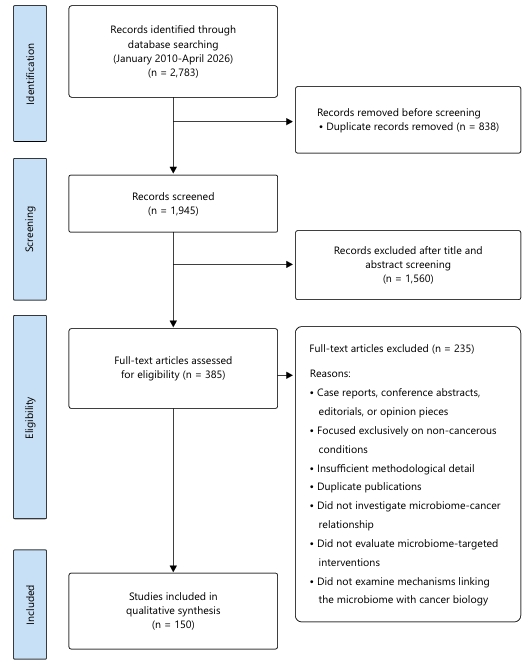
Study selection and data extraction: The initial database search resulted in 2,783 entries. Post de-duplication, 1,945 articles were selected for title and abstract screening. Following the screening,
385 full-text articles were selected to be assessed for eligibility. In total, 150 articles fulfilled the criteria for inclusion in this review. The selection process was performed independently by two reviewers, with any disagreements being resolved via discussion with a third reviewer.
Data extraction included: study design, sample size, type of cancer, microbiome-based intervention (type, dose, duration), method of microbiome analysis, outcomes measured, important findings, and conclusion. In case of clinical studies, patient characteristics, inclusion/exclusion criteria, randomization procedures, and side effects were included. Refer to the PRISMA flow chart in Fig. 1.
Quality assessment: The study quality was determined through design-specific methods, with the Cochrane Risk of Bias Tool used for RCTs, the Newcastle-Ottawa Scale applied to observational studies, and AMSTAR-2 utilized for systematic review and meta-analysis studies. However, no exclusion criteria were used based on the study quality, although the conclusions were drawn with consideration of the methodological strength.
Data synthesis and analysis: Narrative synthesis was chosen to synthesize results and interpret findings. The studies have been grouped on the basis of cancer type, microbiome-based intervention, and their mechanism of action. Quantitative information is shown in tables to enable comparisons among different studies. Because of variation among the studies in terms of methodology, interventions, and outcome measurements, a meta-analysis could not be performed.
Microbiome-cancer axis: Mechanisms and interactions
Microbiome in carcinogenesis: The relationship between the microbiome and cancer development involves multiple complex mechanisms that can either promote or inhibit carcinogenesis. Understanding these mechanisms is foundational to developing effective microbiome-targeted therapies.
Genotoxicity and DNA damage: Some types of bacteria secrete genotoxins, which can directly damage host DNA, leading to carcinogenesis. For instance, colibactin, a genotoxin synthesized by E. coli strains containing pks pathogenicity islands, causes the formation of DNA double-strand breaks and further mutagenic lesions in host cells13. One of the distinctive mutational patterns-adenine N3 alkylation-caused by colibactin has been detected in CRC and some other gastrointestinal tumors, providing one of the most direct mechanisms underlying the link between a commensal bacterium and cancer development.
The BFT secreted by enterotoxigenic B. fragilis strains leads to destruction of E-cadherin-dependent cellular junctions, causing increased epithelial permeability and inflammation as well as DNA damage. The CagA protein encoded by Helicobacter pylori, a WHO Group I carcinogen, induces genetic instability when transferred to gastric epithelium cells, leading to the development of gastric cancer14.
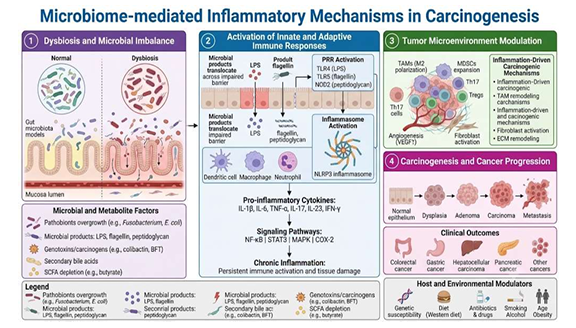
Inflammation and immune modulation: Chronic inflammation is a recognized risk factor for the development of cancer, and the microbiome acts as an important regulator of the inflammatory pathway (Fig. 2). Dysbiosis or microbial imbalance leads to the disruption of the intestinal barrier integrity and facilitates bacterial translocation, causing the activation of pathogen recognition receptors (PRRs), which include Toll-like receptors (TLRs) and NOD-like receptors (NLRs)15.
The activation of PRP induces inflammatory cascade pathways like Nuclear Factor-kappa B (NF-κB) and signal transducer and activator of transcription 3 (STAT3), producing pro-inflammatory cytokines, namely, Tumor Necrosis Factor-alpha (TNF-α), IL-6, and IL-1β. The persistent activation of these pathways results in cell proliferatio n, cell survival, angiogenesis, and metastasis. Segmented filamentous bacteria induce T helper 17 (Th17) cells differentiation, and Th17 cells can either induce or suppress carcinogenesis based on their environment16. In contrast, Faecalibacterium prausnitzii and specific strains of Clostridium help in regulatory T cells (Treg) development by producing SCFA.
|
Metabolite production: The metabolites of microorganisms are important players in the relationship between the microbiome and cancer. Short-Chain Fatty Acids (SCFAs) such as butyrate, propionate, and acetate, obtained from the microbial fermentation of dietary fibers, have a pleotropic effect on cancer development17. Butyrate acts as an important source of energy for colonocytes and is capable of anti-neoplastic activity by inhibiting histone deacetylases (HDACs) to promote genes responsible for cell cycle arrest and apoptosis.
On the other hand, secondary bile acids formed through the microbial modification of primary bile acids have the potential to cause DNA damage, oxidative stress, and intestinal inflammation. Trimethylamine N-oxide (TMAO), which is formed due to the transformation of choline and carnitine in the diet by enzymes mediated by the gut microbiota, has been linked with systemic inflammation and progression of cancer. A recent metabolomics study revealed new metabolites produced by the microbiome of CRC patients, such as p-cresol, polyamines, and indoles18.
Microbiome in cancer therapy response: Beyond carcinogenesis, the microbiome profoundly influences responses to chemotherapy, radiotherapy, and immunotherapy, a recognition that has reshaped the translational landscape of cancer treatment.
|
Chemotherapy: The gut microbiome affects the effectiveness and toxicities of chemotherapeutic agents via different modes. The anti-tumour activity of oxaliplatin is mediated by particular Gram-positive bacteria that activate the production of reactive oxygen species (ROS) by myeloid cells associated with tumours. The effectiveness of cyclophosphamide is also influenced by gut microbiota via modulation of pathogenic Th17 and memory Th1 immune responses19.
Drug metabolism by the microbiome is yet another important mechanism. Certain bacteria that contain β-glucuronidases can activate irinotecan within the gut lumen, increasing toxicity induced by the drug- a clinically significant phenomenon, especially for LMICs due to lack of treatment options20. Other bacterial enzymes can activate prodrugs and make them more effective.
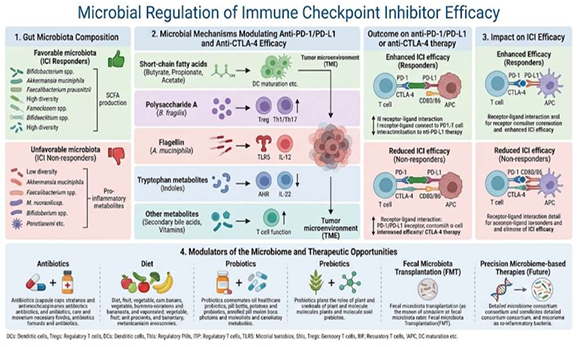
Immunotherapy: The relationship between the microbiome and immunotherapy response has attracted extraordinary attention. Landmark studies demonstrate that gut microbiome composition predicts responses to immune checkpoint inhibitors (ICIs) across multiple cancer types8 (Fig. 3).
The enrichment of Faecalibacterium and Ruminococcaceae correlated with a better systemic immune response against melanoma in patients on PD-1 antibodies treatment [8]. The same bacteria, such as Bifidobacterium longum, Collinsella aerofaciens, and Enterococcus faecium, were enriched in patients who responded to anti-PD-1 treatment. In NSCLC and RCC, taking antibiotics, which alters the gut flora composition, led to a significant reduction in the efficacy of anti-PD-1/PD-L1 treatment; the bacterium Akkermansia muciniphila was found to be responsible for that effect by recruiting CCR9+CXCR3+CD4+T lymphocytes21.
Causal evidence was established through FMT studies: Transfer of fecal material from immunotherapy responders to non-responders with metastatic melanoma resulted in objective tumour responses, accompanied by favourable microbiome changes and enhanced immune cell infiltration11.
Radiotherapy: The gut microbiome also affects responses to radiotherapy, but this link is less well defined. Dysbiosis contributes to microbiome-mediated radiation-induced gastrointestinal toxicity, which results in mucosal damage and inflammation. SCFA produced by Lachnospiraceae and Ruminococcaceae maintain the intestinal barrier function during radiotherapy. Probiotic interventions with Lactobacillus species have shown potential in decreasing radiation-induced gastrointestinal toxicity in preclinical models and small clinical trials, which is particularly relevant for LMICs, where resource constraints in managing radiation-related morbidity often pose a challenge22.
Microbiome-targeted therapies: Current approaches and evidence
Probiotics: Probiotics, defined as live microorganisms that can confer health benefits when administered in adequate amounts, are the most studied microbiome-targeted intervention in cancer and are particularly attractive for LMICs due to their relative affordability and established safety profile in healthy populations.
Preclinical evidence: Several preclinical studies have shown that Lactobacillus and Bifidobacterium species have antitumour potential. Oral administration of Bifidobacterium species improved dendritic cell function and CD8+ T cell priming leading to tumour control similar to anti-PD-L1 therapy in a mouse melanoma model. Combined administration of Bifidobacterium and checkpoint blockade almost completely abolished tumour outgrowth Lactobacillus casei and L. rhamnosus inhibit colorectal carcinogenesis by immunomodulation, enhancement of intestinal barrier function and production of anti-inflammatory metabolites L. rhamnosus GG inhibits the formation of polyps in ApcMin/+ mice by modulating Wnt/β-catenin signalling pathway. Lactobacillus acidophilus suppresses breast cancer growth and metastasis in mice by inducing natural killer (NK) cell activity and reducing Tregs in the tumour microenvironment23.
Clinical evidence: A randomised controlled trial (RCT) evaluating L. rhamnosus GG supplementation in 150 colorectal cancer patients receiving 5-fluorouracil-based chemotherapy found significantly reduced chemotherapy-induced diarrhoea in the probiotic group (grade 3-4 diarrhoea: 22% vs. 37%; p = 0.027). In cervical cancer patients undergoing pelvic radiotherapy, a multi-strain probiotic preparation significantly reduced radiation-induced diarrhoea incidence and severity, with associated quality-of-life improvements24.
A placebo-controlled trial of Lactobacillus casei Shirota in 398 patients investigated recurrence of colorectal tumours after polypectomy over four years. The probiotic group showed significantly lower recurrence of tumours with moderate to severe atypia (relative risk: 0.65, 95% CI: 0.43-0.98; p = 0.04)25. In a phase I trial combining a defined bacterial consortium (11 strains) with anti-PD-1 therapy in metastatic melanoma, several patients who had previously progressed on immunotherapy showed clinical responses following bacterial supplementation.
Prebiotics: Prebiotics, selectively fermented substrates that stimulate beneficial microbiota activity, exert antitumour effects primarily through SCFA production. Common prebiotics include inulin, fructo-oligosaccharides (FOS), galacto-oligosaccharides (GOS), and resistant starch. Their widespread presence in plant-based diets makes them particularly relevant to LMIC settings.
Preclinical evidence: In an ApcMin/+ mouse model of intestinal tumorigenesis, inulin supplementation reduced polyp formation by 40%, associated with increased abundance of butyrate-producing bacteria and elevated caecal butyrate concentrations. Combined FOS and GOS suppressed colitis-associated colorectal cancer in mice more effectively than either prebiotic alone, increasing Bifidobacterium and Faecalibacterium species, enhancing butyrate production, and reducing pro-inflammatory Enterobacteriaceae. Resistant starch supplementation suppressed breast cancer growth and metastasis in mice by modulating systemic inflammation and enhancing antitumour immunity26.
Clinical evidence: A randomised trial evaluating synbiotic intervention (L. rhamnosus GG, Bifidobacterium lactis Bb12, and oligofructose-enriched inulin) in 40 patients at elevated colorectal cancer risk demonstrated significant reductions in colorectal cell proliferation and DNA damage after 12 weeks, alongside favourable microbiome changes and increased faecal SCFA levels. A pilot study of inulin supplementation in 30 NSCLC patients receiving anti-PD-1 therapy suggested safety and potential enhancement of clinical responses, possibly through increased abundance of A. muciniphila and butyrate-producing bacteria27.
Fecal microbiota transplantation: The FMT, the transfer of faecal material from healthy donors to recipients, has mainly been investigated for improving immunotherapy responses and managing treatment-related complications. While procedural requirements limit the immediate application of the approach, emerging evidence offers a robust mechanistic rationale for future adaptation.
Preclinical evidence: The antitumour effects of CTLA-4 blockade are dependent on certain gut microbiota profiles: Germ-free or antibiotic-treated mice had defective responses to CTLA-4 blockade that could be restored by FMT from treatment-responsive donors or colonisation by immunostimulatory Bacteroides species. FMT from responders to anti-PD-1 therapy in cancer patients restored response to PD-1 blockade in germ-free mice associated with increased CD8+ T cell infiltration and activation in the tumour microenvironment.
Clinical evidence: In a phase 1 clinical trial, FMT from immunotherapy responders to 15 PD-1-refractory melanoma patients resulted in favourable microbiome shifts; 3/15 (20%) patients had objective responses. A subsequent phase II trial of FMT plus anti-PD-1 therapy in 30 PD-1-refractory melanoma patients demonstrated an overall response rate of 30% (3 complete responses, 6 partial responses) well above the expected 5-10% response rate of second-line anti-PD-1 therapy in this population11. Moreover, FMT has been reported to be effective as a salvage therapy for steroid-refractory immune checkpoint inhibitor-associated colitis and led to clinical remission in 8 of 10 patients (80%)28.
Small-molecule modulators of the microbiome
Enzyme inhibitors: Bacterial β-glucuronidase inhibitors have demonstrated efficacy in mitigating irinotecan-induced gastrointestinal toxicity by preventing intestinal drug reactivation. A phase I clinical trial confirmed that oral administration of a selective bacterial β-glucuronidase inhibitor was safe and effectively reduced irinotecan-induced diarrhoea in colorectal cancer patients28. Inhibitors of bacterial nitroreductases have similarly been developed to reduce toxicity associated with nitro-containing chemotherapeutics.
Quorum-sensing modulators: Bacterial quorum sensing, a cell-to-cell communication mechanism regulating virulence and biofilm formation, has emerged as a potential anticancer target. A small-molecule inhibitor of the Pseudomonas aeruginosa quorum-sensing system reduced bacterial virulence and enhanced chemotherapy efficacy in a mouse model of pancreatic cancer without affecting bacterial viability, potentially reducing the risk of resistance development.
Postbiotics: Postbiotics, biologically active compounds produced by food-grade microorganisms during fermentation, offer unique advantages: Defined chemical structures and bacterial viability independence potentially enhance safety and stability compared to live probiotic preparations. A postbiotic preparation containing Lactobacillus-derived cell wall components inhibited colorectal cancer development in a mouse model by enhancing mucosal barrier function and modulating innate immune responses. A preliminary study suggested that a heat-killed Lactobacillus preparation may reduce inflammation and improve quality of life in colorectal cancer patients undergoing chemotherapy.
Microbiome-targeted therapies and the hallmarks of cancer: The impact of microbiome-targeted therapies on cancer can be comprehensively understood by examining their effects on the hallmarks of cancer, the fundamental biological capabilities acquired during malignant transformation. Table 1 summarises the influence of various microbiome-targeted therapies on these hallmarks, supported by recent clinical and preclinical studies.
CHALLENGES AND LIMITATIONS IN MICROBIOME-TARGETED CANCER THERAPIES
Despite compelling preclinical and early clinical evidence, multiple challenges must be addressed before microbiome-targeted therapies can be integrated into mainstream cancer care, particularly in LMICs.
Inter-individual variability: High inter-individual variability in microbiome composition and function represents the most fundamental obstacle to standardised microbiome interventions. Variability arises from genetics, diet, geography, lifestyle, and medication use. Probiotic supplementation responses are highly personalised, with some individuals showing robust colonisation and benefit while others demonstrate resistance, a phenomenon termed 'permissiveness', influenced by baseline microbiome composition and host factors29. Developing predictive biomarkers, including baseline microbiome signatures, host genetic variants, and metabolic profiles, is a critical research priority.
Stability and engraftment: Most probiotic strains fail to achieve persistent gut colonisation, with clearance typically occurring within days to weeks after cessation. Contributing factors include competitive exclusion by resident microbiota, host immune mechanisms, and insufficient ecological niches. In FMT, successful donor-derived bacterial engraftment correlates with clinical response, yet the determinants of successful engraftment remain incompletely understood30.
Safety considerations: Safety concerns are amplified in cancer patients who may be immunocompromised or have compromised intestinal barrier function. Probiotic sepsis, though rare, has been reported in immunocompromised patients. FMT carries risks of pathogen transmission, including drug-resistant organisms, a concern with particular weight in LMIC settings where donor screening infrastructure may be limited. Variability in probiotic product viability, purity, and functional activity between manufacturers adds further uncertainty31.
| Table 1: | Impact of microbiome-targeted therapies on the hallmarks of cancer | |||
| Cancer hallmark | Intervention | Mechanism of action | Key outcomes |
| Sustaining proliferative signalling | [object Object] GG Butyrate-producing bacteria (FMT) | Inhibition of Wnt/β-catenin signalling HDAC inhibition | Reduced colorectal polyp formation; decreased β-catenin target gene expression Increased p21 expression; cell cycle arrest in G0/G1 phase |
| Evading growth suppressors | Bacteroides fragilis (probiotic) FMT from healthy donors | Restoration of TGF-β signalling Restoration of p53 function | Increased Smad2/3 phosphorylation; enhanced growth inhibition Reduced intestinal tumour burden; increased p53 target gene expression |
| Resisting cell death | Akkermansia muciniphila | Activation of intrinsic apoptotic pathway | Increased Bax/Bcl-2 ratio; enhanced caspase-3 activation |
| Clostridium butyricum | Butyrate-mediated apoptosis induction | Upregulation of pro-apoptotic proteins; mitochondrial membrane permeabilization | |
| Inducing angiogenesis | Bifidobacterium infantis Butyric acid (postbiotic) |
Inhibition of VEGF signalling Inhibition of HIF-1α |
Reduced VEGF expression; decreased tumour microvessel density Decreased HIF-1α stability; reduced angiogenic factor expression |
| Activating invasion and metastasis | Multi-strain probiotic FOS/GOS (prebiotic) |
Inhibition of epithelial- mesenchymal transition MMP inhibition |
Increased E-cadherin; decreased N-cadherin and vimentin Reduced MMP-2 and MMP-9 expression; decreased cancer cell invasion |
| Avoiding immune | Bifidobacterium species FMT from immunotherapy responders |
Enhanced CD8+ T cell priming Enhanced antigen presentation |
Increased tumour-infiltrating CD8+ T cells; improved anti-PD-L1 response Increased dendritic cell function; enhanced T cell activation |
| Tumour microenvironment modulation | Clostridium butyricum FMT from healthy donors | Conversion of M2 to M1 macrophages Reduction in myeloid-derived suppressor cells | Increased pro-inflammatory macrophage phenotype; enhanced antitumour activity Decreased immunosuppression; enhanced T cell function |
| Deregulating cellular energetics | A. muciniphila | Modulation of glucose metabolism | Shift from glycolysis to oxidative phosphorylation; reduced tumour growth |
| B. fragilis: Bacteroides fragilis, A. muciniphila: Akkermansia muciniphila, C. butyricum: Clostridium butyricum, B. infantis: Bifidobacterium infantis, FMT: Fecal microbiota transplantation, FOS: Fructo-oligosaccharides, GOS: Galacto-oligosaccharides, HDAC: Histone deacetylase, MMP: Matrix metalloproteinase, SCFA: Short-chain fatty acid, TGF-β: Transforming growth factor-β, VEGF: Vascular endothelial growth factor and HIF-1α: Hypoxia-inducible factor-1α | |||
Regulatory and manufacturing challenges: Regulatory frameworks for microbiome-based products vary globally, classified as drugs in some jurisdictions, as food supplements in others. This heterogeneity complicates clinical development and market access, particularly for LMICs with less developed regulatory agencies and limited capacity for independent clinical evaluation. Manufacturing challenges, including maintenance of strict anaerobic conditions, batch-to-batch reproducibility, and scale-up logistics, further constrain availability in resource-limited settings.
Mechanistic understanding and technology limitations: Despite growing evidence, the underlying mechanisms of microbiome-cancer interactions remain incompletely understood. The microbiome-host interface involves metabolic, immune, and neuroendocrine pathways operating simultaneously. Culture-based approaches capture only a fraction of the gut microbiota; sequencing methods provide limited functional resolution. Emerging technologies, culturomics, metaproteomics, and metabolomics, offer deeper functional insights but require infrastructure currently beyond the reach of most LMIC research institutions. Animal model limitations, including species differences in microbiome composition and housing conditions, further constrain translational validity.
LMIC-specific considerations: Microbiome research has been disproportionately conducted in high-income countries (HIC) populations, creating a significant evidence gap for LMIC contexts. Dietary patterns, endemic infections, baseline microbiome composition, antibiotic exposure histories, and co-morbidity profiles differ substantially between populations. The LMIC microbiome is characterised by greater diversity but also higher exposure to enteropathogens and chronic infectious diseases, factors that may alter both the cancer-microbiome relationship and the response to microbiome-targeted interventions32. Furthermore, interventions proven effective in Western populations may not achieve comparable results when applied in sub-Saharan African, South Asian, or Latin American contexts without contextual adaptation.
FUTURE DIRECTIO/NS AND EMERGING APPROACHES
Precision microbiome engineering: Advances in synthetic biology have enabled the design of genetically modified microorganisms, 'living therapeutics', programmed to produce anticancer molecules or modulate immune responses at tumour sites. Escherichia coli Nissle 1917 engineered to secrete anti-PD-L1 nanobodies demonstrated enhanced antitumour effects compared to systemic anti-PD-L1 antibody therapy in colorectal cancer mouse models, potentially reducing systemic toxicity through localised delivery. Lactococcus lactis engineered to express tumour necrosis factor-related apoptosis-inducing ligand (TRAIL) selectively induced apoptosis in cancer cells without affecting normal tissue. CRISPR-Cas9 modification of Bifidobacterium longum enhanced anti-inflammatory metabolite production and efficacy in a colitis-associated colorectal cancer model.
Phage therapy: Bacteriophages, viruses that specifically infect bacteria, enable precise manipulation of the microbiome without the broad disruption caused by antibiotics. Phage-mediated depletion of Fusobacterium nucleatum, a bacterium associated with colorectal cancer progression, reduced tumour growth and metastasis in a mouse model. Engineered phage systems can selectively target pathogens and deliver therapeutic payloads, including CRISPR constructs that eliminate antibiotic resistance genes. For LMICs facing high burdens of antibiotic resistance, phage-based approaches could offer dual benefits in oncology and infectious disease management33.
Artificial intelligence and machine learning: Artificial intelligence (AI) and machine learning (ML) approaches are transforming microbiome research by identifying patterns in complex datasets that predict therapeutic responses. An ML algorithm accurately predicted responses to anti-PD-1 therapy in melanoma using baseline microbiome data, outperforming traditional biomarkers including PD-L1 expression and tumour mutational burden. AI-driven design of personalised probiotic cocktails, optimised for individual baseline microbiome composition, medications, and diet, may overcome the limitations of one-size-fits-all approaches. As sequencing costs continue to decline, AI-microbiome approaches become increasingly relevant even in LMIC research settings.
Combined modality approaches: Integrating microbiome-targeted therapies with conventional cancer treatments offers synergistic potential. Combining Bifidobacterium administration with anti-PD-L1 therapy nearly eliminated tumour outgrowth in mouse models. Microbiome optimisation may reduce the cytotoxic doses required for therapeutic efficacy, minimising toxicity, a highly valuable attribute in LMICs where supportive care for adverse effects is resource-intensive. Microbiome modulation combined with radiotherapy simultaneously enhanced therapeutic efficacy and reduced radiation-induced intestinal injury in preclinical models34.
Novel delivery systems: Encapsulation technologies protect probiotics from gastric acidity, enhancing viability and colonisation potential. Nanoparticle-based delivery of butyrate specifically to the colon overcomes the limitation of proximal absorption. Microfluidic implantable devices enabling controlled release of engineered bacteria could provide sustained microbiome modulation. For LMICs, ower-technology delivery innovations, including optimised fermented food formulations harnessing indigenous strains, dietary fibre enrichment programmes, and community-based probiotic delivery models, may offer more immediately scalable pathways35.
Research priorities for low- and middle-income country settings: Moving forward requires a focused research agenda on the development of microbiome-targeted therapies for cancer in LMICs. This would include (i) Characterizing baseline microbiome profiles in LMIC cancer populations to provide standards and identify LMIC specific microbes associated with clinical response, (ii) Testing dietary and prebiotic interventions including native plant based foods with high fermentable fiber as cost effective and acceptable microbiome modifying tools for oncology supportive care, (iii) Generating and testing local affordable probiotics made from native bacterial species, (iv) Investigating the influence of endemic co-infectious diseases (malaria, helminths, HIV) and antibiotic use on the microbiome-cancer interactions and treatment efficacy; (v) lmiclead sponsored clinical trials with microbiome-targeted interventions for important cancers in LMICs such as cervical cancer, hepatocellular cancer and esophageal cancer and (vi) Building expertiseand facilities for microbiome analysis and longitudinal studies.
CONCLUSION
This review discusses the human microbiome as a critical player in cancer and a valuable therapeutic avenue. Microbiome interactions may promote carcinogenesis and impact response to therapy via genotoxicity, inflammation, and product metabolites. Currently available therapeutic strategies, including probiotics, prebiotics, and fecal transplantation, show therapeutic promise as we have seen in initial studies, demonstrating effectiveness in improving cancer immunotherapies and diminishing toxicities.
Despite these advances, the transferability of microbiome-targeted approaches worldwide remains limited by interindividual variability and safety. Most significantly, research to date is disproportionately focused in high-income nations, with very limited evidence on its transferability into LMICs. Nevertheless, microbiome approaches present tremendous opportunities for LMICs because low-cost and easy-to-integrate therapies, including high-fiber foods, fermented foods, and affordable probiotics, can be seamlessly introduced into routine community-based healthcare delivery models.
Future opportunities exist in promoting LMIC-based diverse and well-designed clinical studies that will employ a harmonized set of methodologies and invest in capacity building. Investing in the promise of an equitable science will set us on course toward genuinely personalized and universally accessible cancer care at the point of need.
SIGNIFICANCE STATEMENT
The microbiome has become an important factor in regulating human physiology. Its role is seen not only in immune regulation but also in metabolism and the development of various diseases. New therapies that include probiotics, prebiotics, and faecal microbiota transplantation have revolutionized the treatment of inflammatory disorders, infections, metabolic conditions, and even cancer. The use of these new therapies, along with immunotherapies, has tremendous promise for boosting effectiveness and reducing treatment side effects. It is especially important for low- and middle-income countries, where new, inexpensive microbiome-based treatment approaches can make a big difference.
ACKNOWLEDGMENT
The authors acknowledge the editorial team of Academia Oncology for their leadership in convening the Special Issue 'Strengthening Cancer Care in Low- and Middle-Income Countries,' and the broader scientific community whose published research constitutes the evidence base of this review. The authors acknowledge the use of AI tools (Claude AI and Microsoft Copilot) for language editing and image design support. All scientific content reflects the authors' own expertise and judgment, and the use of these tools was managed responsibly and ethically in accordance with Academia.edu Journals' adherence to COPE guidelines on AI in publication ethics.
REFERENCES
- Toydemir, S. and G. Merey, 2026. Biochemistry of human gut microbiota: Related diseases and dietary interactions. Molecules, 31.
- Xavier, J.B., V.B. Young, J. Skufca, F. Ginty and T. Testerman et al., 2020. The cancer microbiome: Distinguishing direct and indirect effects requires a systemic view. Trends Cancer, 6: 192-204.
- Helmink, B.A., M.A.W. Khan, A. Hermann, V. Gopalakrishnan and J.A. Wargo, 2019. The microbiome, cancer, and cancer therapy. Nat. Med., 25: 377-388.
- Bray, F., M. Laversanne, H. Sung, J. Ferlay, R.L. Siegel, I. Soerjomataram and A. Jemal, 2024. Global cancer statistics 2022: GLOBOCAN estimates of incidence and mortality worldwide for 36 cancers in 185 countries. CA: Cancer J. Clinicians, 74: 229-263.
- Strasser-Weippl, K., Y. Chavarri-Guerra, C. Villarreal-Garza, B.L. Bychkovsky and M. Debiasi et al., 2015. Progress and remaining challenges for cancer control in Latin America and the Caribbean. Lancet Oncol., 16: 1405-1438.
- Mafe, A.N. and D. Büsselberg, 2025. Microbiome integrity enhances the efficacy and safety of anticancer drug. Biomedicines, 13.
- Zitvogel, L., Y. Ma, D. Raoult, G. Kroemer and T.F. Gajewski, 2018. The microbiome in cancer immunotherapy: Diagnostic tools and therapeutic strategies. Science, 359: 1366-1370.
- Gopalakrishnan, V., C.N. Spencer, L. Nezi, A. Reuben and M.C. Andrews et al., 2017. Gut microbiome modulates response to anti-PD-1 immunotherapy in melanoma patients. Science, 359: 97-103.
- Yu, T., F. Guo, Y. Yu, T. Sun and D. Ma et al., 2017. Fusobacterium nucleatum promotes chemoresistance to colorectal cancer by modulating autophagy. Cell, 170: 548-563.e16.
- Song, Y., M. Shi and Y. Wang, 2024. Deciphering the role of host-gut microbiota crosstalk via diverse sources of extracellular vesicles in colorectal cancer. Mol. Med. 30.
- Davar, D., A.K. Dzutsev, J.A. McCulloch, R.R. Rodrigues and J.M. Chauvin et al., 2021. Fecal microbiota transplant overcomes resistance to anti-PD-1 therapy in melanoma patients. Science, 371: 595-602.
- Round, J.L. and N.W. Palm, 2018. Causal effects of the microbiota on immune-mediated diseases. Sci. Immunol., 3.
- Jung, S., 2026. Microbiome-genome crosstalk in colorectal cancer: Colibactin signatures and Fusobacterium nucleatum in epidemiology, driver selection, and translation. Int. J. Mol. Sci., 27.
- Capparelli, R. and D. Iannelli, 2022. Epigenetics and Helicobacter pylori. Int. J. Mol. Sci., 23.
- Wong, S.H. and J. Yu, 2019. Gut microbiota in colorectal cancer: Mechanisms of action and clinical applications. Nat. Rev. Gastroenterol. Hepatol., 16: 690-704.
- Yano, J.M., K. Yu, G.P. Donaldson, G.G. Shastri and P. Ann et al., 2015. Indigenous bacteria from the gut microbiota regulate host serotonin biosynthesis. Cell, 161: 264-276.
- Koh, A., F. de Vadder, P. Kovatcheva-Datchary and F. Bäckhed, 2016. From dietary fiber to host physiology: Short-chain fatty acids as key bacterial metabolites. Cell, 165: 1332-1345.
- Wu, Y., N. Shen, C. Hope, H.I. Noh, B.N. Richardson, M.C. Swartz and J. Bai, 2024. A systematic review of the gut microbiome, metabolites, and multi-omics biomarkers across the colorectal cancer care continuum. Benefic. Microbes, 15: 539-563.
- Viaud, S., F. Saccheri, G. Mignot, T. Yamazaki and R. Daillère et al., 2013. The intestinal microbiota modulates the anticancer immune effects of cyclophosphamide. Science, 342: 971-976.
- Lin, H.Y., C.Y. Chen, T.C. Lin, L.F. Yeh and W.C. Hsieh et al., 2021. Entropy-driven binding of gut bacterial β-glucuronidase inhibitors ameliorates irinotecan-induced toxicity. Commun. Biol., 4.
- Routy, B., E.L. Chatelier, L. Derosa, C.P.M. Duong and M.T. Alou et al., 2018. Gut microbiome influences efficacy of PD-1-based immunotherapy against epithelial tumors. Science, 359: 91-97.
- Chen, L., H. Li, J. Li, Y. Chen and Y. Yang, 2019. Lactobacillus rhamnosus GG treatment improves intestinal permeability and modulates microbiota dysbiosis in an experimental model of sepsis. Int. J. Mol. Med., 43: 1139-1148.
- Belanger, C.R., M. Dostert, T.M. Blimkie, A.H.Y. Lee and B.K. Dhillon et al., 2022. Surviving the host: Microbial metabolic genes required for growth of Pseudomonas aeruginosa in physiologically-relevant conditions. Front. Microbiol., 13.
- Chitapanarux, I., T. Chitapanarux, P. Traisathit, S. Kudumpee, E. Tharavichitkul and V. Lorvidhaya, 2010. Randomized controlled trial of live lactobacillus acidophilus plus bifidobacterium bifidum in prophylaxis of diarrhea during radiotherapy in cervical cancer patients. Radiat. Oncol., 5.
- Ishikawa, H., I. Akedo, T. Otani, T. Suzuki and T. Nakamura et al., 2005. Randomized trial of dietary fiber and Lactobacillus casei administration for prevention of colorectal tumors. Int. J. Cancer, 116: 762-767.
- Singh, V., B.S. Yeoh, R.E. Walker, X. Xiao and P. Saha et al., 2019. Microbiota fermentation-NLRP3 axis shapes the impact of dietary fibres on intestinal inflammation. Gut, 68: 1801-1812.
- Sheng, W., G. Ji and L. Zhang, 2023. Immunomodulatory effects of inulin and its intestinal metabolites. Front. Immunol., 14.
- Wang, Y., D.H. Wiesnoski, B.A. Helmink, V. Gopalakrishnan, K. Choi et al., 2018. Fecal microbiota transplantation for refractory immune checkpoint inhibitor-associated colitis. Nat. Med., 24: 1804-1808.
- Alshatari, S.S. and M. Ziarno, 2026. Probiotic-driven competitive exclusion in the human gut: A meta-analysis of microbial diversity and pathogen suppression. Nutrients, 18.
- Ruan, Y., T. Zhu, R. Yang, F. Su and C. An et al., 2025. Donor-derived microbial engraftment and gut microbiota shifts associated with weight loss following fecal microbiota transplantation. Appl. Environ. Microbiol., 91.
- Churin, A.A., L.O. Sokolyanskaya, A.P. Lukina and O.V. Karnachuk, 2026. Current concepts in probiotic safety and efficacy. Nutrients, 18.
- Aggarwal, N., S. Kitano, G.R.Y. Puah, S. Kittelmann, I.Y. Hwang and M.W. Chang, 2023. Microbiome and human health: Current understanding, engineering, and enabling technologies. Chem. Rev., 123: 31-72.
- Ayele, A.A., W. Liu, M. Xiao, A.A. Kalayu, W.E. Abegaz and A.A. Negash, 2026. Reimagining phage therapy for MDR pathogens: From biobanks to health system integration-a review. Infect. Dis. Ther., 15: 941-957.
- Li, L., Z. Yang, Y. Yi, Y. Song and W. Zhang, 2025. Gut microbiota and radiation-induced injury: Mechanistic insights and microbial therapies. Gut Microbes, 17.
- Dhiman, S., S. Kaur, B. Thakur, P. Singh and M. Tripathi, 2025. Nutritional enhancement of plant-based fermented foods: Microbial innovations for a sustainable future. Fermentation, 11.
How to Cite this paper?
APA-7 Style
Adekola,
S.A., Igbayilola,
Y.D., Oparinde,
D.P., Aina,
S.O., Audu,
N.M. (2026). Microbiome-Host-Cancer Interface: A Narrative Review of Therapeutic Strategies, Current Challenges, and Global Opportunities. Trends in Medical Research, 21(1), 87-100. https://doi.org/10.3923/tmr.2026.87.100
ACS Style
Adekola,
S.A.; Igbayilola,
Y.D.; Oparinde,
D.P.; Aina,
S.O.; Audu,
N.M. Microbiome-Host-Cancer Interface: A Narrative Review of Therapeutic Strategies, Current Challenges, and Global Opportunities. Trends Med. Res 2026, 21, 87-100. https://doi.org/10.3923/tmr.2026.87.100
AMA Style
Adekola
SA, Igbayilola
YD, Oparinde
DP, Aina
SO, Audu
NM. Microbiome-Host-Cancer Interface: A Narrative Review of Therapeutic Strategies, Current Challenges, and Global Opportunities. Trends in Medical Research. 2026; 21(1): 87-100. https://doi.org/10.3923/tmr.2026.87.100
Chicago/Turabian Style
Adekola, Saheed, Ayodeji, Yusuf Dimeji Igbayilola, Dolapo Pius Oparinde, Samson Olawale Aina, and Ngabea Murtala Audu.
2026. "Microbiome-Host-Cancer Interface: A Narrative Review of Therapeutic Strategies, Current Challenges, and Global Opportunities" Trends in Medical Research 21, no. 1: 87-100. https://doi.org/10.3923/tmr.2026.87.100

This work is licensed under a Creative Commons Attribution 4.0 International License.
